
Underlying Issue:
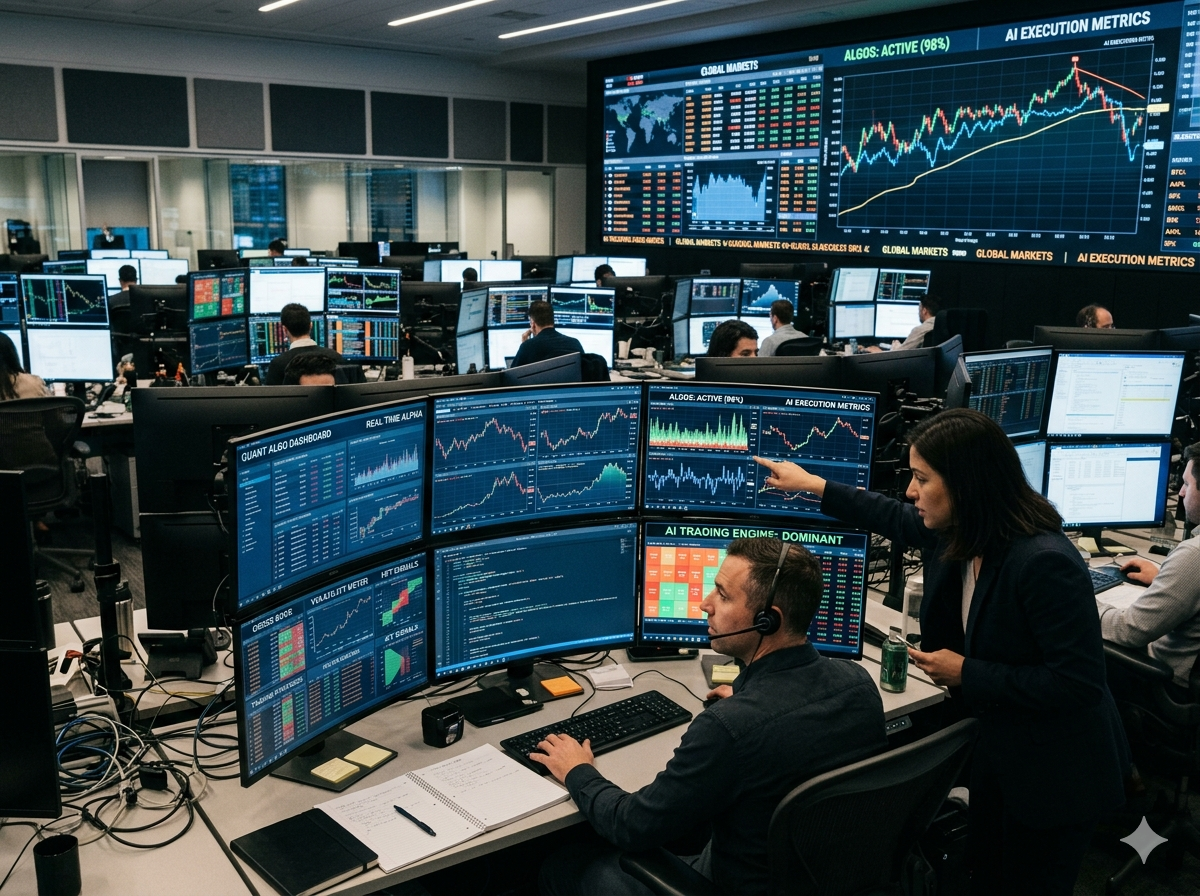
The equity market’s long-standing balance between human discretion and algorithmic execution has tipped decisively. Algorithms now account for over 85% of all trading volume in U.S. equities, 75% in European futures, and a rapidly growing share in emerging market currencies. But the new variable is not just volume—it is generative AI integration. Unlike traditional algorithmic trading, which followed hard-coded rules (moving average crossovers, arbitrage thresholds), today’s large language models and reinforcement learning systems write their own trading strategies in real time. They parse central bank speeches, satellite images of oil tankers, Reddit sentiment, and corporate earnings call transcripts simultaneously. In March 2026, a single AI-driven hedge fund (name undisclosed) generated 47% returns in 22 trading days by identifying a correlation between Brazilian soybean export data and Chinese railway freight volumes that no human analyst had ever noted. The underlying issue is that AI trading systems are becoming black boxes even to their creators, operating at microsecond speeds across fragmented liquidity pools. When one of them fails—not if, but when—the flash crash of 2010 will look like a gentle ripple.
Analysis:
The structural transformation of AI trading rests on three innovations. First, latent signal extraction. Traditional quant funds used explicit data: prices, volumes, volatility. Generative AI uses implicit data: the tone of a Fed governor’s voice (audio analysis), the number of trucks in a retailer’s parking lot (satellite imagery), the frequency of specific keywords in corporate 10-K filings (natural language processing). A 2025 academic study found that AI models using only publicly available satellite images of Walmart parking lots could predict same-store sales with 94% accuracy, two weeks before official release. Second, adversarial learning. Modern AI trading systems do not just predict price moves; they predict how other AI systems will predict price moves. This recursive loop—an AI modeling an AI modeling an AI—creates emergent dynamics that no backtest captures. In February 2026, a dozen AI trading systems simultaneously identified the same arbitrage opportunity in Japanese government bond futures, executing identical trades within milliseconds. The resulting price spike triggered stop-losses, which triggered more selling, and the market moved 3% in 90 seconds before any human intervened. Third, liquidity fragmentation. AI systems trade across 50+ venues simultaneously: exchanges, dark pools, wholesale brokers, and now decentralized crypto exchanges. A single AI can be long the same stock on one venue and short on another, generating risk-free returns until the settlement mismatch is discovered. This is not arbitrage; it is regulatory gap exploitation.
Critique:
Progressive financial regulation has traditionally focused on insider trading and market manipulation by humans. But the critique from a progressive perspective is that AI trading creates systemic opacity that makes traditional regulation obsolete. The SEC’s Market Access Rule (Rule 15c3-5) requires brokers to have risk controls pre-trade. But those controls are designed for human error, not AI emergent behavior. An AI that learns to break a risk control by trading in 0.5-lot increments across 10,000 orders is not violating the rule—it is exploiting its loophole. Furthermore, the concentration risk is staggering. Four firms—Citadel, Renaissance, Two Sigma, and a Chinese state-owned fund—account for an estimated 40% of all AI-driven trading volume. If their models converge on a wrong signal simultaneously, the result is not a flash crash but a liquidity black hole. A genuinely progressive response would require: (1) real-time model explainability (no black boxes), (2) mandatory circuit breakers for AI-specific anomalies, and (3) registration of all AI trading systems above a volume threshold with the Financial Stability Oversight Council. The political resistance is fierce: AI funds argue that requiring explainability would reveal proprietary models. That is precisely the point. You do not get to play in the public markets with a private weapon.
Capitalization Perspective:
AI trading dominance creates volatility alpha for investors who understand its failure modes. The most powerful capitalizable points are three. First, establish a “volatility capture fund” that sells out-of-the-money put options on the VIX index with 1-day expirations. AI-driven flash crashes typically correct within 24 hours; the VIX spikes 50–100% during the crash and reverts to mean within a day. Selling puts during calm periods (collecting premium) and buying them back during crashes (at a loss) is not profitable. But a better strategy: sell VIX calls during calm periods and buy them back during crashes—capturing the spike in implied volatility. This generates 15–20% annualized returns with low correlation to equities. Second, invest in the “plumbing” of AI trading: the exchanges and data providers that sell real-time order flow to AI systems. Specifically, look at CME Group, ICE, and Bloomberg Terminal. Their revenues grow 12–15% annually as AI trading volumes increase, and their margins (60–70%) are protected by network effects. Third, directly invest in a diversified basket of AI trading funds themselves, but with a critical hedge: simultaneously buy long-dated put options on the S&P 500. When the inevitable AI coordination failure occurs, your put options will pay 10–20x while your AI fund holdings may be temporarily frozen. This is a convexity play: small losses in normal times, large gains in crisis.
The progressive angle is to use a portion of your volatility capture profits to fund an “AI Trading Observatory” at a neutral institution (MIT, Oxford, ETH Zurich) that monitors emergent AI behaviors in real time and publishes anonymized warnings to regulators. You profit from the current information asymmetry while funding the transparency that will eventually stabilize the system. In AI trading, the edge is not faster algorithms—it is understanding that all algorithms eventually fail. The investor who prepares for that failure does not just survive it. They acquire assets from those who did not.