
Underlying Issue:
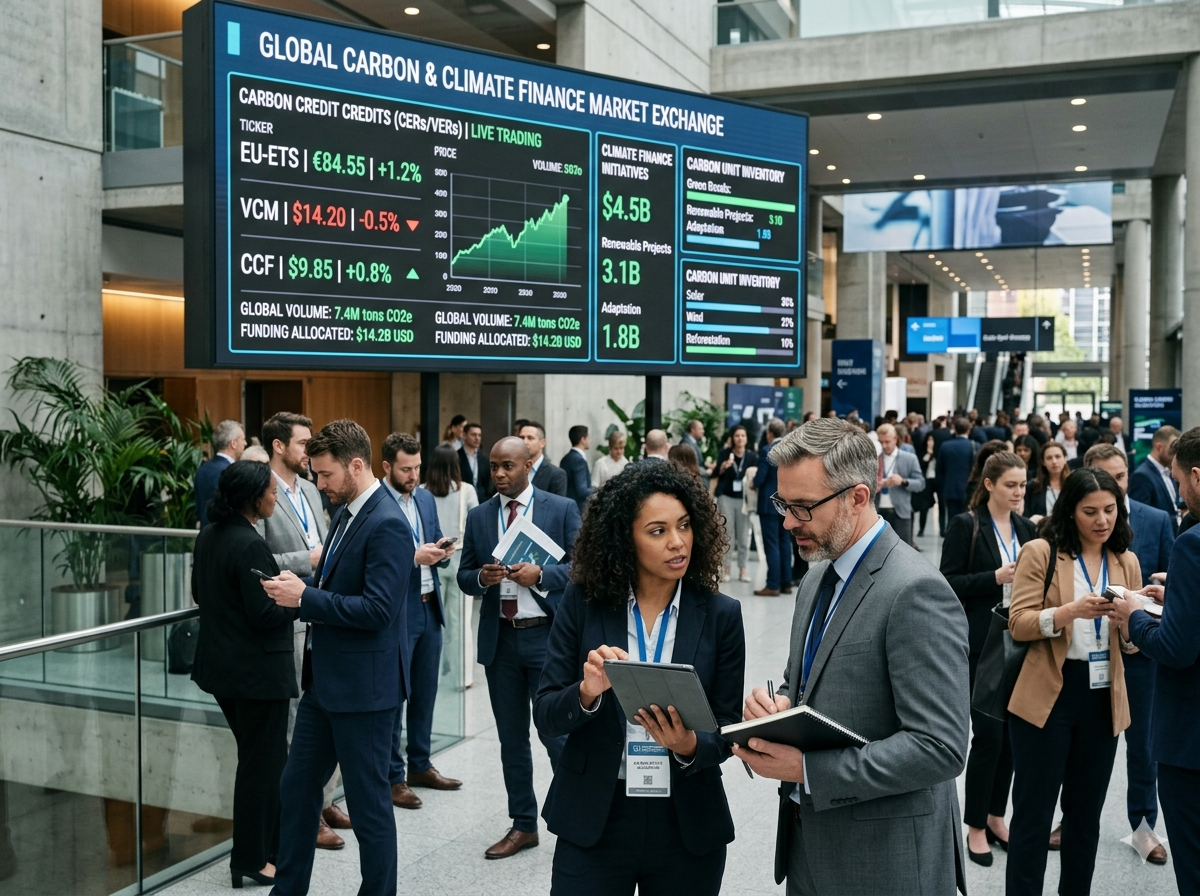
For two decades, carbon markets promised to turn emissions reductions into tradable assets—a elegant mechanism where price signals would allocate capital toward decarbonization. That promise has collided with an uncomfortable reality. Global carbon markets now exceed $1 trillion in notional value, yet they are failing to deliver the one thing that matters: verifiable, additional, permanent emissions reductions. The underlying issue is not a lack of trading volume or financial innovation. It is a crisis of integrity. The voluntary carbon market has been rocked by scandals revealing that 80–90% of rainforest offset credits do not represent real carbon reductions. The compliance markets (EU ETS, California Cap-and-Trade) are more robust but cover less than 20% of global emissions and have been gamed via free allowances and carbon leakage exemptions. Meanwhile, Article 6 of the Paris Agreement—supposedly the global rulebook for carbon trading—has become so complex that only a handful of trades have actually settled. UHNW investors are now asking a blunt question: is carbon a genuine asset class, or a moralized derivative destined for regulatory crackdown?
Analysis:
The structural pathology of carbon markets is best understood through the lens of additionality. A carbon credit represents one ton of CO2 that would not have been avoided without the financial incentive of selling the credit. In practice, proving additionality is nearly impossible. A forest that was not going to be cut down anyway generates credits that are pure financial rent. The 2025 investigation into Verra, the world’s largest carbon credit certifier, found that 94% of its rainforest credits failed additionality tests. Yet those credits traded at $8–12 per ton, were bought by Shell, Disney, and Microsoft, and were retired as “carbon neutral” claims. The compliance markets have a different problem: price suppression. The EU ETS price should be at €100 per ton to drive industrial decarbonization; it has averaged €65 over the past year because heavy emitters receive free allowances that they sell for profit. This is not a carbon market; it is a subsidy to polluters dressed in green clothing. The third problem is durability. A forest can burn. A soil carbon project can be reversed by the next farmer. A carbon credit that is not permanent is not a ton of CO2 avoided—it is a ton deferred. Yet permanence is rarely contractually guaranteed, leaving buyers holding worthless paper after a single wildfire season.
Critique:
A progressive perspective should champion carbon pricing as the most efficient climate policy. But the current iteration of carbon markets is not efficient—it is a moral hazard disguised as environmentalism. The critique is that corporations use cheap, fraudulent credits to delay real operational decarbonization. Microsoft buys offsets instead of redesigning its supply chain. Delta Air Lines claims carbon neutrality while burning jet fuel. This is not a market failure; it is a design failure that progressive policymakers enabled by prioritizing speed over rigor. The 2022 decision by the Integrity Council for Voluntary Carbon Markets (ICVCM) to establish a “Core Carbon Principles” framework was a step forward, but its thresholds remain too low: credits can be certified with only 30-year permanence, even though atmospheric CO2 lasts millennia. A genuinely progressive reform would require: (1) independent additionality verification by a public body, not private certifiers; (2) 100-year permanence with legal liability for reversals; and (3) a ban on using carbon credits for “carbon neutral” marketing claims. Without these reforms, carbon markets are a reputational time bomb for any UHNW investor who touches them.
Capitalization Perspective:
The crisis of integrity is also a valuation arbitrage. The most powerful capitalizable point is that high-integrity carbon credits—those that survive scrutiny—will trade at a massive premium to low-integrity credits. That premium is currently 5–10x. Here is how to capture it. First, launch a “Carbon Integrity Fund” that buys only Article 6.4 credits (the Paris Agreement’s high-integrity mechanism) and credits from direct air capture (DAC) facilities with verifiable permanence. DAC credits currently trade at $300–$600 per ton; as voluntary markets collapse, corporations desperate to salvage ESG commitments will bid these up to $800–$1,200 per ton. Your fund buys at $400, holds for 24 months, sells at $900. Expected IRR: 50–80%. Second, short the low-integrity credit indexes (e.g., the Global Carbon Index’s voluntary component) via total return swaps, while going long high-integrity credits. This pairs trade captures the divergence as institutional buyers flee low-quality credits. Third, invest directly in carbon credit litigation finance. Lawsuits against Verra, Shell, and Delta for fraudulent offset claims are proliferating. Financing these lawsuits at 15–20% interest rates, with a success fee of 30% of settlements, yields high risk-adjusted returns. The trigger: a 2026 class action against Verra alleging RICO violations is likely to settle for $500 million–$1 billion.
The progressive angle is explicit. Use a portion of your Carbon Integrity Fund’s profits to endow a “Carbon Credit Oversight Board” housed at a respected university (Columbia, Oxford, Tsinghua), tasked with publishing real-time integrity ratings for all credit types. You profit from the current information asymmetry while funding the transparency that will eventually eliminate it. In carbon markets, as in all markets, information is the ultimate arbitrage. The investor who brings integrity to a system built on its absence does not just earn returns—earns legitimacy. That is the rarest alpha of all.