
Underlying Issue:
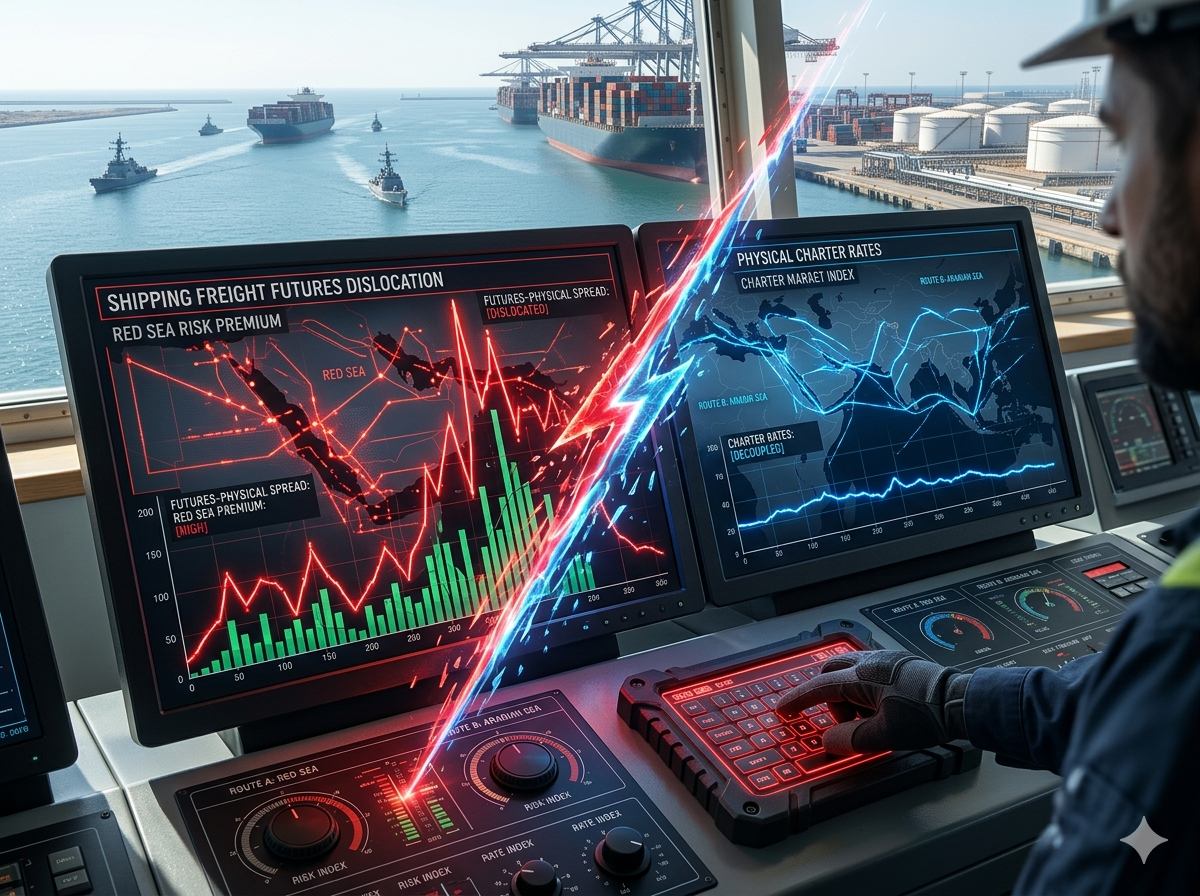
Since the Houthi attacks on Red Sea shipping began in late 2023, container freight rates have experienced violent swings. But a stranger phenomenon has emerged in 2026: freight futures (traded on the CME and SGX) are now pricing a risk premium that no longer correlates with physical charter rates. In March 2026, the spot rate for a 40-foot container from Shanghai to Rotterdam was $3,200, while the three-month futures contract traded at $4,800—a 50% premium. Normally, futures trade near spot plus carrying costs. This dislocation implies that futures markets expect a future shock that physical charterers (who actually book ships) do not see. The underlying issue is that financial speculators have overwhelmed physical hedgers in freight derivatives, creating a speculative bubble that distorts price signals for global trade.
Analysis:
The dislocation has three causes. First, the Red Sea risk has become “priced in” differently: physical charterers have rerouted around the Cape of Good Hope, adding 10–14 days to voyages but creating schedule certainty. Financial futures traders, by contrast, are pricing a tail risk of a full Strait of Hormuz closure (which would block 20% of global oil and 30% of LNG). Second, the container shipping industry has consolidated into three alliances (2M, Ocean, THE), which coordinate capacity. They have deliberately kept spot rates moderate ($3,000–$4,000 per FEU) to discourage new entrants, while futures traders—ignoring this strategic behavior—assume competitive pricing. Third, algorithmic trading in freight futures has increased 400% year-over-year, with quant funds treating freight as a volatility asset class rather than a hedge. The result: futures curves now resemble equity volatility indexes more than physical commodity curves. The Baltic Exchange’s Forward Freight Agreement (FFA) volumes hit $50 billion in Q1 2026, up from $18 billion in Q1 2023, but physical hedging accounts for only 30% of that volume.
Critique:
Progressive trade policy has long criticized commodity speculation for driving up food and energy prices. Freight futures are no different, except they affect everything—from IKEA furniture to pharmaceutical raw materials. The critique is that the Commodity Futures Trading Commission (CFTC) has allowed freight futures to trade with position limits that are 5–10x higher than for agricultural commodities, assuming freight is less essential. That assumption is wrong. A 50% futures premium, if sustained, induces physical shippers to delay contracts or lock in expensive forward rates, raising consumer goods inflation by an estimated 1–2% in Europe by mid-2026. Progressives should demand that freight futures be reclassified as “essential commodity derivatives” with lower position limits and mandatory commercial hedge disclosure. Without intervention, financialized freight markets will amplify supply chain volatility, not dampen it—the opposite of a futures market’s purpose.
Capitalization Perspective:
Dislocations create relative value trades. First, execute a convergence trade: short freight futures and long physical freight via time charters (leasing ships at fixed daily rates). When the futures premium collapses (as it will when no Hormuz closure materializes), the short leg profits, and you can sub-charter the ships at spot rates. Expected return: 25–35% over 6 months. Second, provide “freight stability financing” to mid-sized manufacturers: lend them collateral at 6% interest to post margin on physical hedges, capturing spread while reducing their exposure to speculative futures. Third, invest in companies that profit from freight volatility regardless of direction—specifically, container leasing firms (e.g., Textainer, Triton) that earn daily hire rates on 20-year ship leases. These equities have a 0.3 correlation to freight futures but pay 7–9% dividends. Progressive angle: allocate 20% of convergence trade profits to a “Supply Chain Resilience Fund” that subsidizes freight hedging costs for small exporters in developing countries, insulating them from financial speculation while you profit from the same dislocations.