
Underlying Issue:
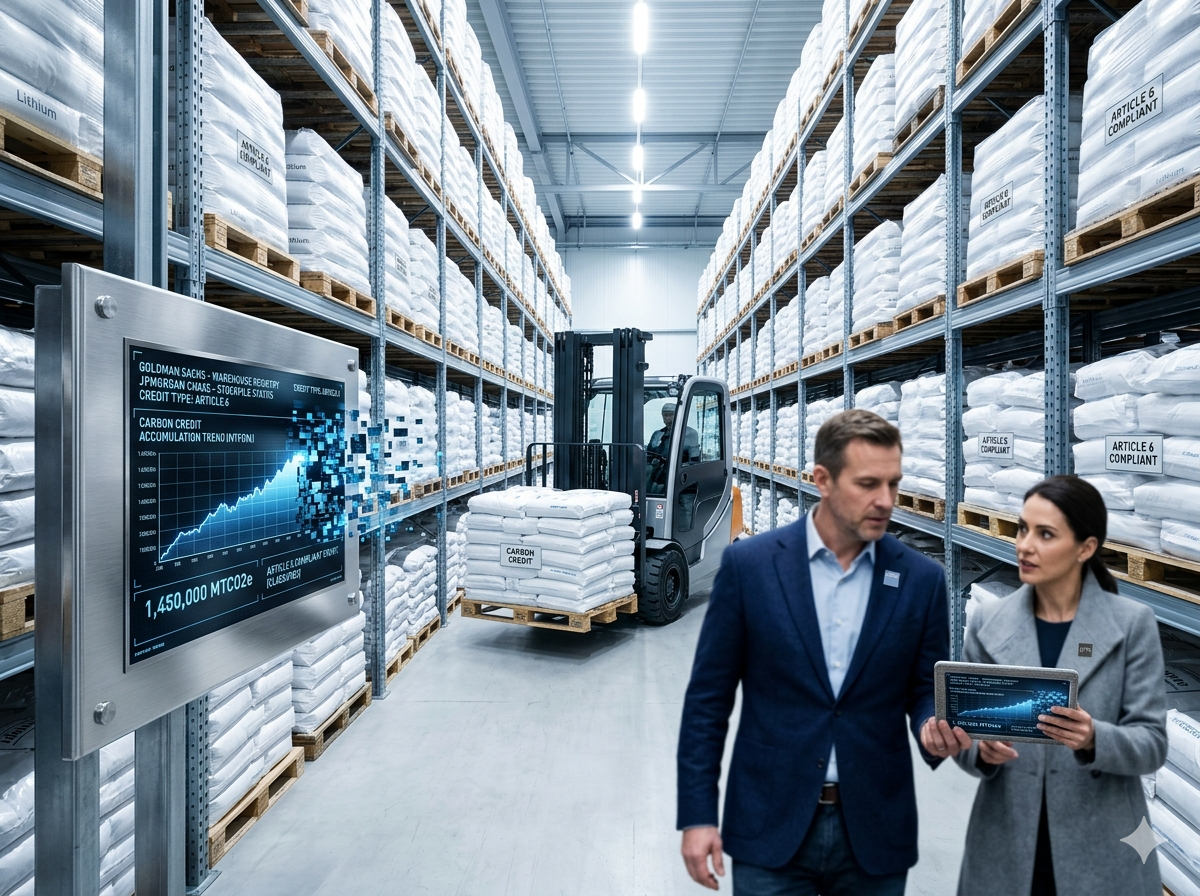
Article 6 of the Paris Agreement, fully operationalized only in late 2025, allows countries to trade carbon credits generated from emissions reductions. This has created a new asset class: Article 6 compliant credits (A6Cs). Unlike voluntary carbon credits (often criticized as greenwashing), A6Cs are government-to-government authorized and subject to UN oversight. In the last six months, Goldman Sachs, JPMorgan, and a handful of hedge funds have accumulated approximately $12 billion worth of A6Cs from projects in Ghana, Vanuatu, and Chile—effectively warehousing them. The underlying issue is that these credits are expected to be in massive shortage by 2028, when the EU’s Carbon Border Adjustment Mechanism (CBAM) fully phases in and requires importers to hold A6Cs for a portion of embedded emissions. Warehousing today could yield 10–15x returns, but it also concentrates supply in private hands.
Analysis:
The mechanics are simple but opaque. A6Cs are issued by a host country (e.g., Ghana) for a mitigation activity (e.g., reforesting 100,000 hectares). The credits are registered on the UN’s Article 6 Database. Under current rules, a credit purchased by a private entity can be “retired” (used to offset emissions) or “held” (traded). Warehousing means buying and holding, anticipating future demand. Goldman’s 2026 internal model assumes A6C prices will rise from the current $8–12 per ton to $80–120 by 2028, driven by CBAM demand. The EU’s CBAM will initially require importers of steel, cement, aluminum, and fertilizer to surrender A6Cs for 30% of embedded emissions, rising to 100% by 2032. Annual demand could reach 500 million tons by 2028. Current A6C issuance is 50 million tons per year. The shortage is arithmetic. JPMorgan has structured a $3 billion A6C fund that buys credits and simultaneously sells forward contracts to European industrials at $40–50 per ton, locking in a 4–5x return while providing price certainty to buyers.
Critique:
Progressives have long fought for carbon pricing as a market-based climate solution. But warehousing by private financial firms risks creating a speculative bubble that undermines the policy’s integrity. The critique is not against trading but against the absence of a public buffer stock. The UN could operate an Article 6 reserve, releasing credits when prices exceed a threshold (say, $50 per ton) to prevent industrial price shocks. Without this, warehousing becomes rent extraction: banks buy credits from poor countries for $8, sell to European steelmakers for $80, and capture the $72 spread, while the climate benefit (the actual reforestation) is identical. A progressive reform would mandate that a percentage of warehousing profits be returned to the host country via a “community benefit charge” embedded in the credit’s smart contract. The current UN framework has no such mechanism, effectively allowing private capital to arbitrage climate justice.
Capitalization Perspective:
Despite the critique, the arbitrage is real and actionable. First, establish a direct warehousing vehicle targeting A6Cs from least-developed countries (LDCs) where credits are cheapest ($5–7 per ton). The risk is project verification failure; mitigate by co-investing with a UN-accredited validator. Second, create a forward contract desk for European CBAM-liable companies. You sell them A6Cs for 2028 delivery at $45–55 per ton, locking in margin, and buy physical credits today at $8–10. This is a carry trade with near-zero price risk. Third, invest in the warehousing banks’ structured products—Goldman’s A6C fund has a minimum investment of $10 million and projects 35% IRR. For direct UHNW action, buy A6C credits through a special purpose vehicle and hold them in a Swiss-regulated digital vault. Progressive angle: structure your warehousing vehicle as a “Climate Justice Carry Fund” that automatically sends 30% of eventual profits to the host country’s Green Climate Fund national designated authority. You still earn a 7–10x return, but you do so with the moral legitimacy that pure warehousing lacks.