
Underlying Issue:
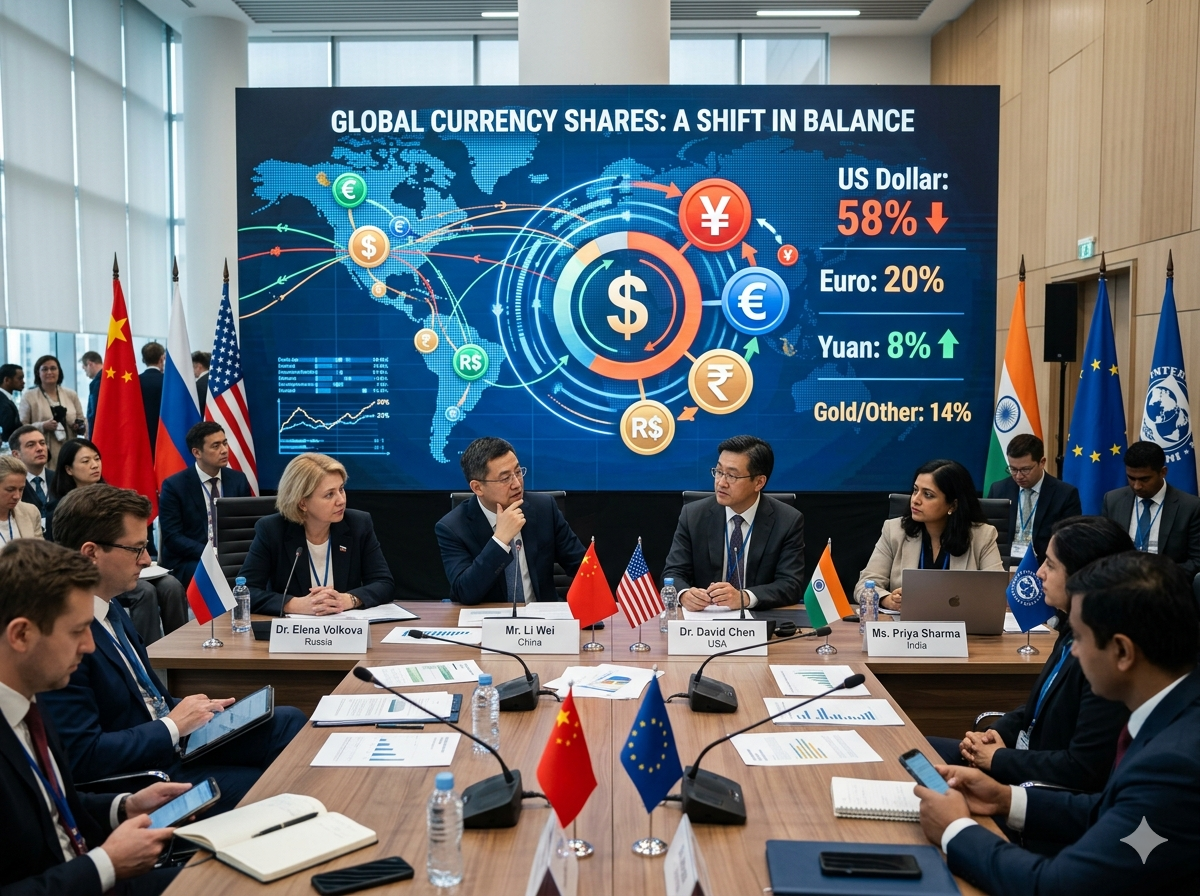
For eighty years, the U.S. dollar has been the world’s dominant reserve currency—the medium for global trade, the store of value for central banks, and the unit of account for commodities. That era is not ending abruptly, but it is eroding measurably. The dollar’s share of global reserves has fallen from 72% in 2000 to 58% in 2025—a 14 percentage point decline that represents trillions of dollars in diversification. Central banks are buying gold at the fastest pace since 1967. China, Russia, Brazil, India, and South Africa (BRICS) have expanded their contingency reserve arrangement to reduce dollar dependence. Saudi Arabia is accepting renminbi for oil sales to China. The underlying issue is not whether the dollar will be replaced—no single currency has the depth, rule of law, or network effects to do so soon. The issue is that the dollar’s status is no longer unquestioned. For UHNW families, a multipolar reserve system means higher transaction costs, more volatile exchange rates, and the need to hold a broader basket of currencies. But it also means arbitrage opportunities across payment systems, interest rate differentials, and geopolitical risk premia that did not exist a decade ago.
Analysis:
The drivers of de-dollarization fall into three categories. First, weaponization risk. The U.S. freeze of $300 billion in Russian central bank assets in 2022 sent a clear signal: dollar reserves are not safe from political seizure. Any country that fears future U.S. sanctions—China, Saudi Arabia, India, Turkey—has an incentive to reduce dollar holdings. China now holds only 45% of its reserves in dollars, down from 65% in 2015. Second, infrastructure development. China’s Cross-Border Interbank Payment System (CIPS) processed $15 trillion in 2025, up 40% year-over-year. India’s Unified Payments Interface (UPI) now connects to Singapore’s PayNow and the UAE’s Aani. These systems reduce the need for dollar intermediation. A trade between India and Russia can now settle in rupees and rubles via their respective domestic systems, bypassing SWIFT and dollar clearing entirely. Third, interest rate divergence. The Fed’s aggressive tightening made dollar borrowing expensive. Countries with dollar-denominated debt face service costs that are 500–800 basis points higher than local currency alternatives. This has spurred a wave of liability management: Mexico issued €4 billion in euro-denominated bonds to retire dollar debt; Turkey swapped $2 billion of dollar debt for yuan liabilities. These are not symbolic gestures—they are rational portfolio choices.
Critique:
Progressive internationalism has long criticized dollar hegemony for giving the U.S. unilateral power over the global financial system. A multipolar reserve system is, in principle, more democratic and stable. But the critique from a progressive perspective is that de-dollarization, as currently unfolding, is not a transition to multilateralism—it is a fragmentation into rival blocs. China wants the renminbi to replace the dollar, not to share power. Russia wants to create a gold-backed currency that excludes the West. The BRICS are not building a shared payments system; they are building parallel systems that favor their respective national champions. A genuinely progressive outcome would be a truly neutral reserve asset—an expanded Special Drawing Right (SDR) basket administered by the IMF, with regular rebalancing and no veto power for any single country. But the U.S. has blocked SDR expansion, China has blocked IMF governance reform, and Europe is preoccupied with its own strategic autonomy. The result is not a managed transition but a chaotic drift. Progressives should demand that their governments engage in multilateral reserve reform before fragmentation becomes irreversible.
Capitalization Perspective:
De-dollarization creates structural arbitrage opportunities across currencies, commodities, and geographies. The most powerful capitalizable points are three. First, establish a “reserve transition fund” that holds a basket of emerging market currencies (renminbi, rupee, real, dirham) weighted by their central bank reserve accumulation. As the dollar’s share declines, these currencies will appreciate against the dollar. The fund can be structured as a passive ETF or an actively managed currency overlay. Expected annual return: 4–6% from appreciation plus 2–3% from carry (interest rate differentials). Second, go long gold. Central banks are buying gold not as a speculation but as a hedge against dollar weaponization. In 2025, central bank gold purchases were 1,200 tons, the second-highest on record. Gold currently trades at $2,400 per ounce. A continuation of current purchase rates would push gold to $3,000–3,500 within 24 months. Use futures or physically allocated bullion. Third, invest in the payment infrastructure companies that enable cross-bloc settlement. Specifically, look at Wise (cross-border payments), FXC Intelligence (currency data), and regional champions like India’s NPCI International. These companies benefit regardless of which currency wins—they just need more currencies to move between.
The progressive angle is to use a portion of your reserve transition profits to fund a “Multilateral Reserve Reform Initiative” at a neutral institution (Brookings, Chatham House, Bruegel) that designs a practical roadmap for SDR expansion and IMF governance reform. You profit from the current fragmentation while funding the research that could eventually overcome it. In currency markets, the most patient capital does not pick winners. It builds the infrastructure that makes picking winners less necessary. That is the true hedge against hegemony—and a return profile that no single currency can match.