
Underlying Issue:
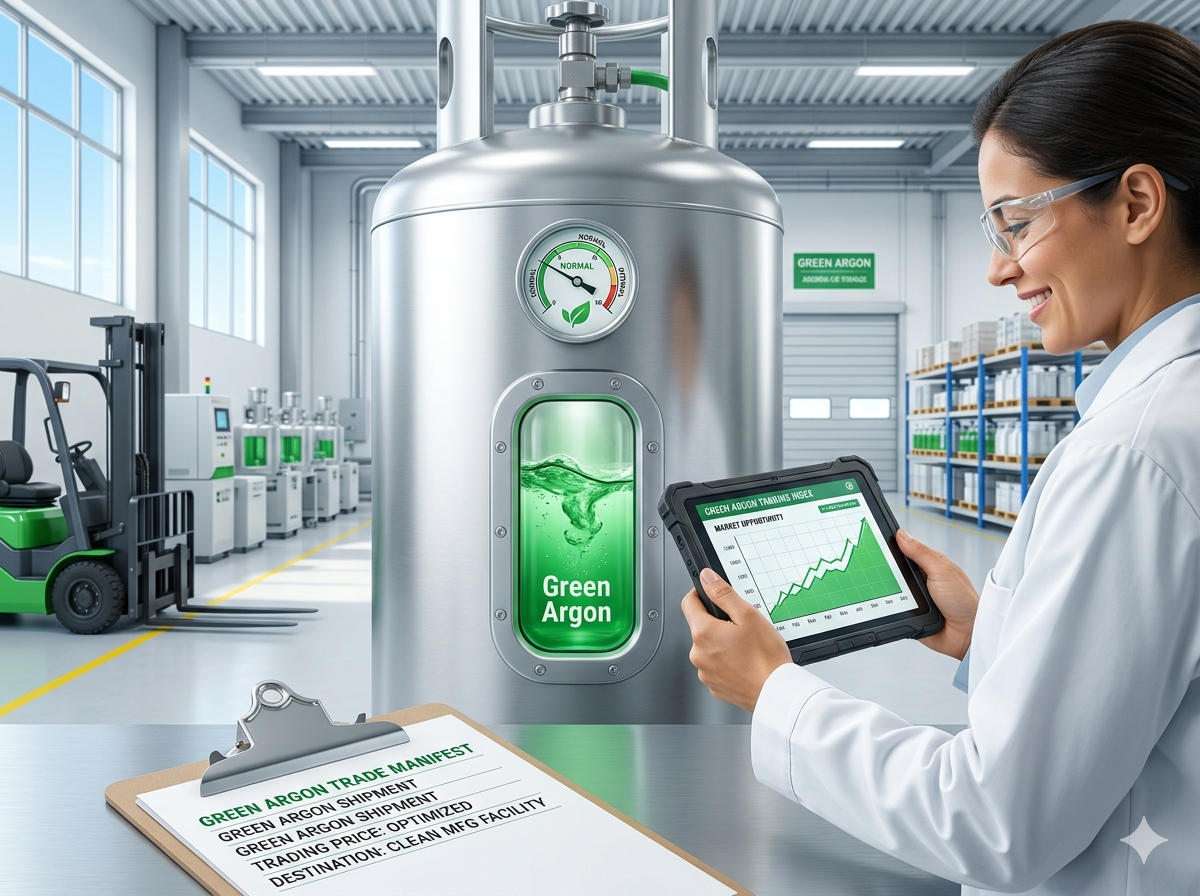
Argon is the third-most abundant gas in the atmosphere but surprisingly difficult and energy-intensive to purify. It is essential for semiconductor manufacturing (laser gas), solar panel production, and stainless steel making. Historically priced at $0.50–$0.80 per cubic meter, green argon—produced using renewable energy rather than fossil-powered cryogenic separation—has emerged as a distinct asset class in 2026. The twist: green argon trades at a 300–500% premium to grey argon, but production is highly sensitive to renewable intermittency. A two-week lull in North Sea wind can spike Dutch green argon prices from $2.50 to $8.00 per cubic meter, creating arbitrage opportunities across the EU-South Korea-Japan triangle.
Analysis:
The green argon market is where energy transition meets industrial physics. Argon is a byproduct of liquid oxygen and nitrogen production in air separation units (ASUs). A standard ASU uses 0.5 MWh of electricity per ton of argon. If that electricity is wind- or solar-sourced, the argon qualifies as “green” under EU CBAM and U.S. Inflation Reduction Act rules for embedded carbon content. But renewable power is variable; when the wind stops, green ASUs either shut down (losing argon production entirely) or draw from the grid (losing green certification). That binary outcome creates extreme price volatility. In March 2026, a 10-day Dunkelflaute (low wind and solar) across Germany caused green argon prices to spike 340%, while grey argon moved only 12%. South Korean chipmakers, who need green argon for EU-exported semiconductors, paid the premium. Physical storage is limited because argon is a cryogenic liquid requiring specialized tanks—no one holds more than 30 days of inventory.
Critique:
Progressive climate policy has focused on renewable electricity and electric vehicles, not industrial gases. That is a blind spot. The Inflation Reduction Act’s 45X tax credit for clean manufacturing components assumes green inputs are reliably available. They are not. The critique is that carbon border adjustment mechanisms (CBAM) create green argon demand but provide no supply-side stability mechanism. This is a market design failure. A more progressive approach would treat argon as a strategic reserve material, similar to petroleum in the Strategic Petroleum Reserve. The EU could maintain a green argon buffer stock, releasing it during renewable lulls to cap prices. Without such intervention, green argon volatility will either force manufacturers to stockpile (inefficient) or revert to grey argon and pay CBAM penalties (defeating the climate goal).
Capitalization Perspective:
Volatility is opportunity. First, finance the construction of dedicated green argon storage hubs at major industrial ports (Rotterdam, Ulsan, Singapore). Lease storage capacity to semiconductor fabs on long-term contracts with a variable fee tied to spot volatility—earning you 15–20% unlevered returns. Second, create a green argon futures contract on a regulated exchange (CME or EEX). As a market maker, you capture bid-ask spreads of 3–5% during volatile periods. Third, invest in modular, containerized ASUs that can be moved between renewable-rich regions (e.g., Chilean solar, Icelandic geothermal) to chase the green premium. These units cost $10–15 million each and can generate $5–7 million in annual gross margin at current spreads. Progressive angle: allocate part of your storage fund to offer discounted green argon to small European manufacturers during renewable droughts, smoothing their input costs while capturing the long-term value of industrial decarbonization.