
Underlying Issue:
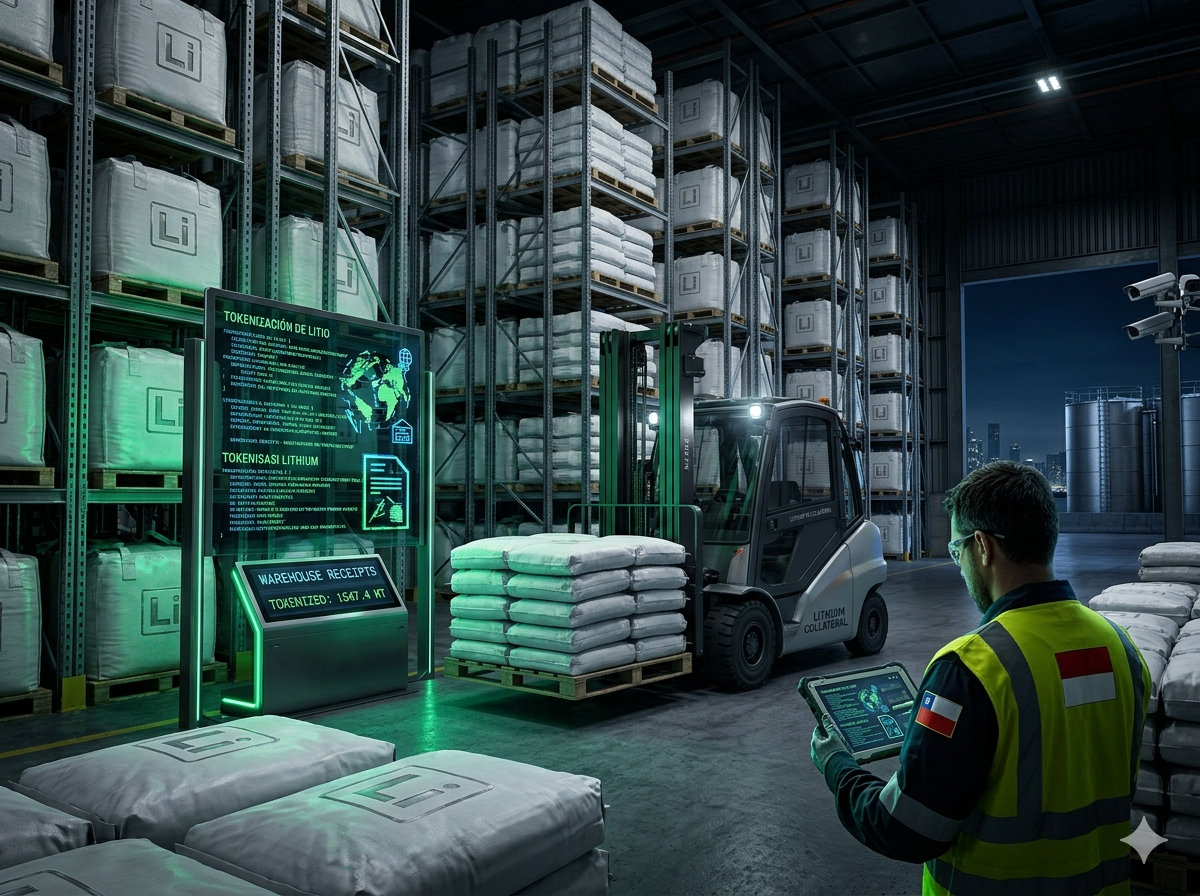
Lithium prices have fallen 60% from their 2022 peak but remain strategic. Chile (Atacama) and Indonesia (downstream refining) are pioneering a new financial instrument: tokenized lithium warehouse receipts. A miner deposits physical lithium carbonate or hydroxide into a bonded warehouse, receives a digital token (on a private blockchain) representing that specific lot, and uses the token as collateral for dollar or yuan loans. The innovation is not just digitization but fractionalization—a single 20-ton container can be tokenized into 20,000 one-kilogram receipts, each tradeable. This opens lithium financing to UHNW families who would never take physical delivery but will accept tokenized collateral. The underlying issue is price volatility: lenders demand 50–60% haircuts, but tokenization reduces transaction costs from 5% to 0.5%, unlocking billions in locked working capital.
Analysis:
The mechanism is modeled on London Metal Exchange warrants but with blockchain settlement. Chile’s National Lithium Company (Codelco’s new unit) issues a “LiToken” for each warehouse receipt. The token contains metadata: purity (99.5% min), origin (Salar de Atacama), carbon footprint, and buyer of record. A bank like BCI Chile lends 40% of spot value against the token at SOFR + 300 bps. If the borrower defaults, the bank can sell the token on a secondary exchange (e.g., the Santiago Mineral Exchange). The token trades at a 2–5% discount to physical lithium due to illiquidity but offers instant settlement. Indonesia is copying the model for nickel and copper. By April 2026, tokenized lithium collateral outstanding reached $4.2 billion, up from zero in 2024. The Bank for International Settlements has designated this “Minerals 2.0” as a priority area for digital finance regulation.
Critique:
Progressives have long argued that commodity-exporting countries capture too little value from their resources. Tokenization could change that by enabling direct monetization without selling equity to foreign miners. But the critique is that tokenization also enables speculative hoarding and price manipulation. A single family office could buy 5% of all outstanding LiTokens, demand physical delivery, and create a short squeeze—something impossible in the physical market due to shipping constraints. Furthermore, the energy consumption of blockchain validation (even private chains) conflicts with the green image of lithium for EVs. A truly progressive approach would require that tokenized lithium receipts include a “community royalty” smart contract: each token transfer automatically sends 0.5% of value to a local development fund in the Atacama, which is currently water-stressed from mining. Without such mechanisms, tokenization extracts value without redistributing it.
Capitalization Perspective:
The lithium token market is young, inefficient, and profitable. First, become a market maker on the Santiago Mineral Exchange, capturing bid-ask spreads of 1–2% on LiTokens. With daily volume now $200 million, a 1% spread equals $2 million per day in gross revenue. Second, create a lithium token arbitrage fund that buys tokens at a 4% discount to physical lithium, simultaneously shorts physical lithium futures on the CME, and captures the convergence. This pairs trade carries near-zero delta risk and yields 8–12% annualized. Third, provide “liquidity backstop” financing: lend against LiTokens at 50% loan-to-value but with a 20% liquidation buffer. When borrowers default, you take the tokens and sell into physical markets. Progressive angle: set up your arbitrage fund as a certified B Corp, with 10% of profits automatically flowing to the Atacama Water Trust for desalination and indigenous land rights. You profit from lithium while mitigating its most morally problematic externality.