
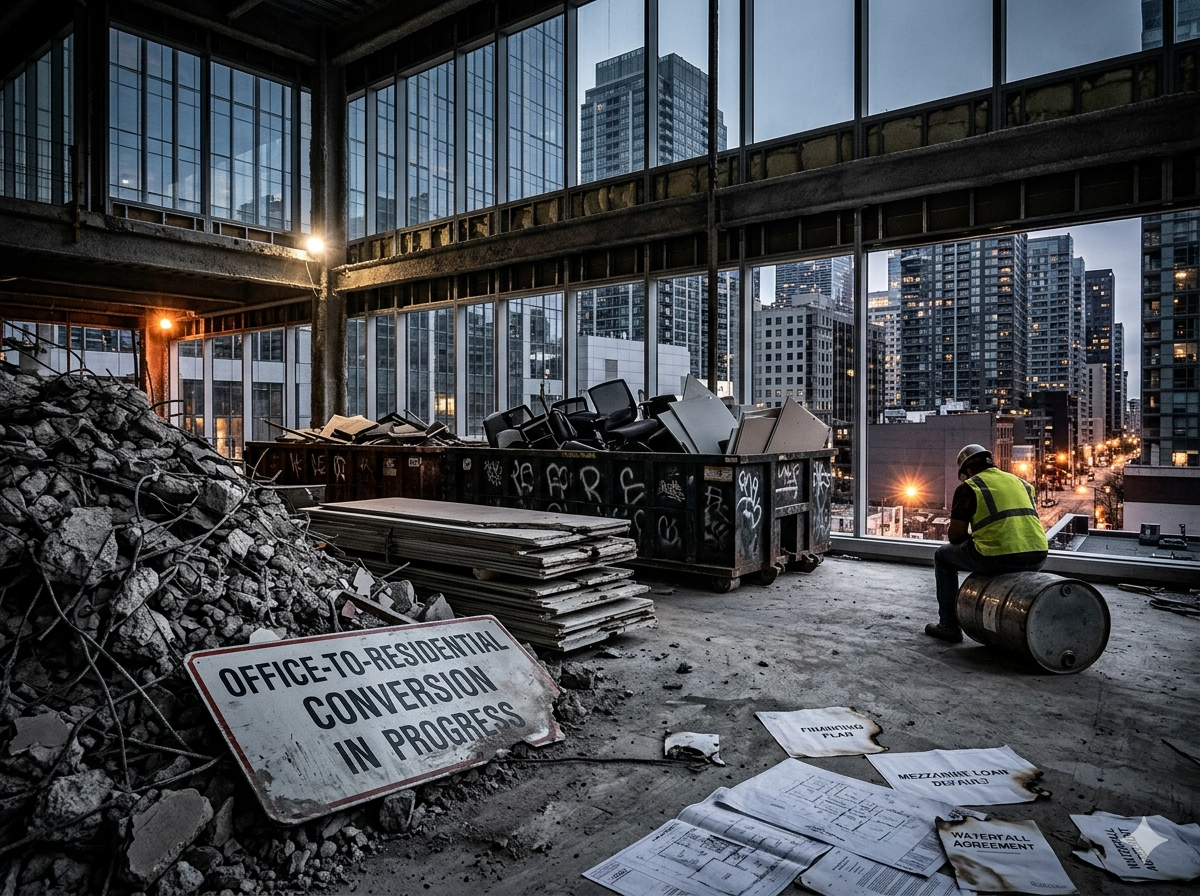
Underlying Issue:
The post-pandemic migration to hybrid work has left central business districts from San Francisco to Frankfurt with 30–40 percent office vacancy rates. Conventional wisdom prescribed conversion to residential as a win-win: alleviate housing shortages while salvaging asset values. Yet beneath the surface, a technical financial pathology has emerged—stranded rent. When a Class B or C office building converts to apartments, the net operating income (NOI) often drops 40–60 percent because residential rents per square foot typically underperform office rents even in weak markets. That drop in NOI triggers an immediate violation of debt service coverage ratios (DSCRs) on mezzanine debt, which was underwritten to office income trajectories. Senior lenders get paid first; mezzanine tranches find themselves with no cash flow to service, causing a waterfall collapse that leaves mezz investors with worthless paper while senior lenders take possession of half-empty residential shells.
Analysis:
The mechanism is straightforward but underappreciated: office leases are triple-net with longer terms (7–15 years) and higher per-square-foot rents; residential leases are gross, shorter (12–24 months), and yield lower PSF even at luxury prices. A 200,000 square foot office building generating $60 PSF office rent ($12M NOI pre-debt) converts to 200 units at 1,000 SF each. Top-tier residential rents in secondary CBDs average $4.50–$5.50 PSF, or roughly $54,000 per unit annually—just $10.8M gross rent, against higher residential operating costs (individual HVAC, garbage, concierge). Result: NOI falls to $6–7M. That 40–50 percent decline violates DSCR covenants on mezz debt (typically set at 1.25x–1.35x). Mezz investors, often pension funds and family offices seeking yield, find their interest payments cease. Senior lenders accelerate, foreclose, and auction the now-residential asset at a 30–40 percent discount to the original office valuation. The mezz tranche is wiped out entirely.
Critique:
Progressive urban policy has championed office-to-residential conversion as a climate-friendly, housing-supply solution. New York’s Office Conversion Accelerator Act and London’s Permitted Development Rights expansion implicitly assumed that buildings can change use without financial engineering consequences. This is naive. The critique from a progressive standpoint is not that conversions should stop, but that regulators and lenders have allowed mezzanine debt structures to persist with false rent assumptions. Underwriting standards failed to incorporate use-case elasticity: the same square footage is not fungible across income streams. Furthermore, tax incentives (e.g., accelerated depreciation for residential) often accrue to senior lenders after foreclosure, not to the original developers or mezz investors. This creates a moral hazard: senior lenders have an incentive to push weak conversions into default to capture tax benefits, while mezz investors are structurally set up to lose.
Capitalization Perspective:
For UHNW individuals and institutional investors, the stranded rent phenomenon opens three distinct capital opportunities. First, purchase mezzanine debt on office assets slated for conversion at 10–20 cents on the dollar. If the conversion proceeds, the mezz position is worthless—but many conversions will stall due to permitting or construction financing gaps. In those stalls, the mezz debt becomes the fulcrum security in bankruptcy-style negotiations. Aggressive investors can buy mezz claims and then negotiate a debt-for-equity swap, taking control of the residential conversion at a fraction of replacement cost. Second, provide “rescue capital” in the form of preferred equity that sits above the mezz but below the senior loan. This paper can be structured with a 15–18 percent current pay and a conversion kicker if the senior lender forecloses. Third, short the senior lenders’ stock (regional banks heavily exposed to CBD office debt) using total return swaps, while buying out-of-the-money puts on CMBS indices. As conversions accelerate in 2026–2027, senior lender losses from foreclosed residential shells will surprise to the downside. The progressive angle: use these profits to seed a “Housing Resilience Fund” that buys foreclosed residential shells at steep discounts and converts them to permanently affordable cooperative housing—capturing both financial alpha and policy alignment.