
Underlying Issue:
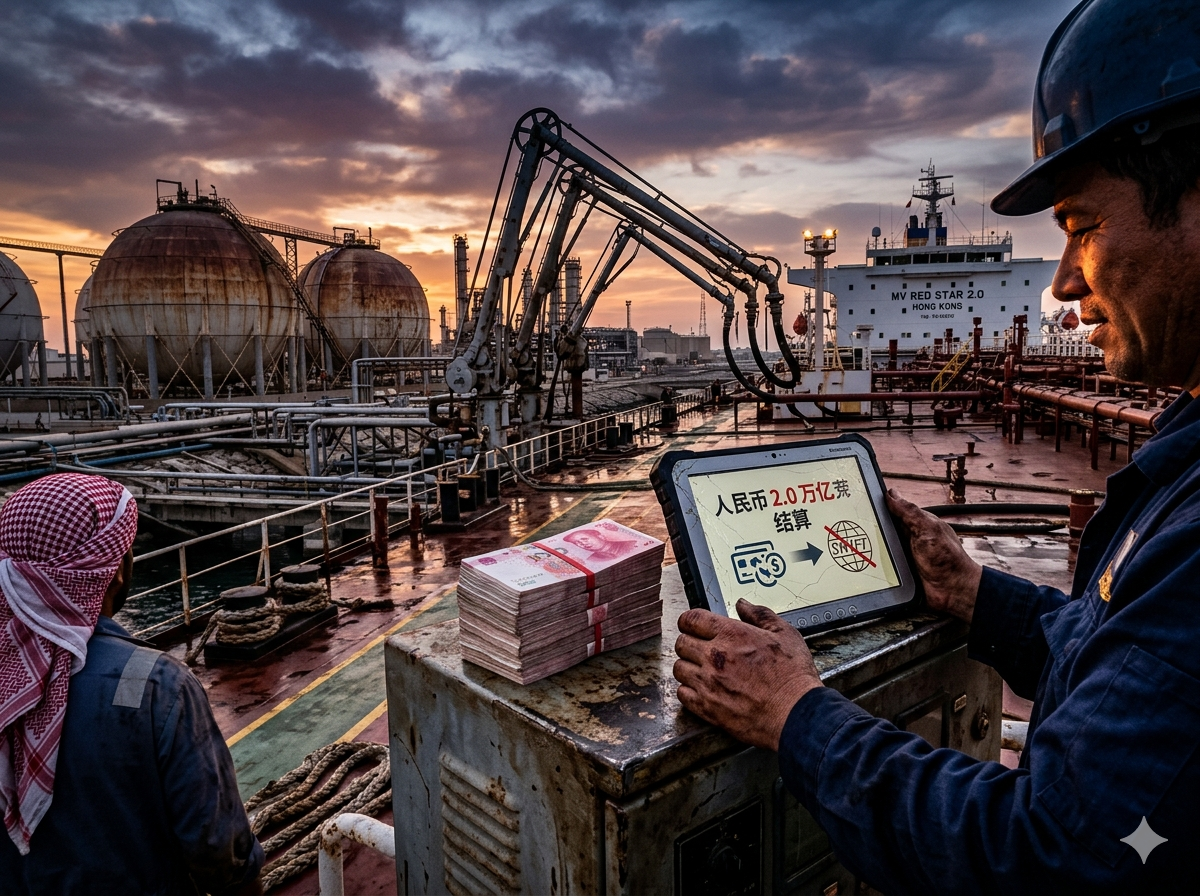
For decades, the petrodollar system meant oil traded in dollars, cleared through SWIFT and U.S. correspondent banks. That is quietly ending. In the last 12 months, China, Russia, Saudi Arabia, Iran, and Venezuela have settled approximately $2.1 trillion in oil and gas trades using offshore renminbi (CNH) via China’s Cross-Border Interbank Payment System (CIPS). No SWIFT messages, no U.S. bank intermediaries. This is not a forecast—it is a live parallel system. For UHNW portfolios, the question is not whether the renminbi will challenge the dollar but how to monetize the transition’s frictions: CNH liquidity mismatches, time-zone settlement gaps, and the spread between onshore and offshore renminbi.
Analysis:
CIPS now has 1,500 direct participants and 12,000 indirect participants across 110 countries. Direct settlement in CNH bypasses SWIFT entirely, though many banks run CIPS and SWIFT in parallel. The oil-specific innovation is the Shanghai Oil & Gas Exchange’s “Yuan Settlement Mechanism”: a buyer (say, an Indian refiner) deposits CNH into an escrow account at a CIPS participant bank; the seller (a Russian oil major) draws CNH upon delivery. No dollars change hands. But CNH is not freely convertible; it trades at a 1–3% discount to onshore CNY. The People’s Bank of China (PBOC) manages that spread via a daily fixing and a 20,000 CNH per day individual conversion limit—but corporate limits are negotiated case by case. This creates a two-tier offshore market: “clean CNH” (freely traded) and “dirty CNH” (subject to PBOC approval). Oil traders increasingly demand clean CNH, driving a wedge that reached 180 bps in March 2026.
Critique:
Progressive internationalists have long criticized dollar hegemony for giving the U.S. unilateral sanction power. A multipolar currency system is, in principle, more democratic and stable. The critique is not that CNH oil trade is bad but that it remains opaque and politically captured. China has used CNH settlement to reward allies (Russia, Pakistan) and punish opponents (Australia’s LNG now trades at a CNH discount). Furthermore, the PBOC’s ability to shut down CNH convertibility overnight—as it did briefly in 2015—creates settlement risk that no private contract can fully hedge. Progressives should demand a truly multilateral settlement currency, not just a swap of dollar hegemony for renminbi hegemony. The ideal is a Special Drawing Right (SDR)-denominated oil contract, not another unipolar system.
Capitalization Perspective:
The CNH oil trade creates three actionable dislocations. First, establish a CNH-USD arbitrage desk in Abu Dhabi or Hong Kong, capturing the 1–3% onshore-offshore spread via cross-border trade finance loops. This can generate 8–12% annualized risk-adjusted returns. Second, invest in CIPS-compatible payment technology firms (e.g., Beijing-based Midex) that are building the middleware for CNH oil settlement. These firms will IPO at 10–15x revenue within 24 months. Third, provide CNH liquidity to smaller oil traders who cannot access PBOC swap lines. You lend CNH at SOFR + 500 bps against dollar collateral, earning a safe spread while facilitating the new oil order. Progressive angle: use a portion of profits to fund legal research at the WTO and IMF on binding rules for reserve currency behavior—transparency, no sudden convertibility changes, and nondiscriminatory access—to ensure the multipolar system serves global stability, not just Chinese state interests.