
Underlying Issue:
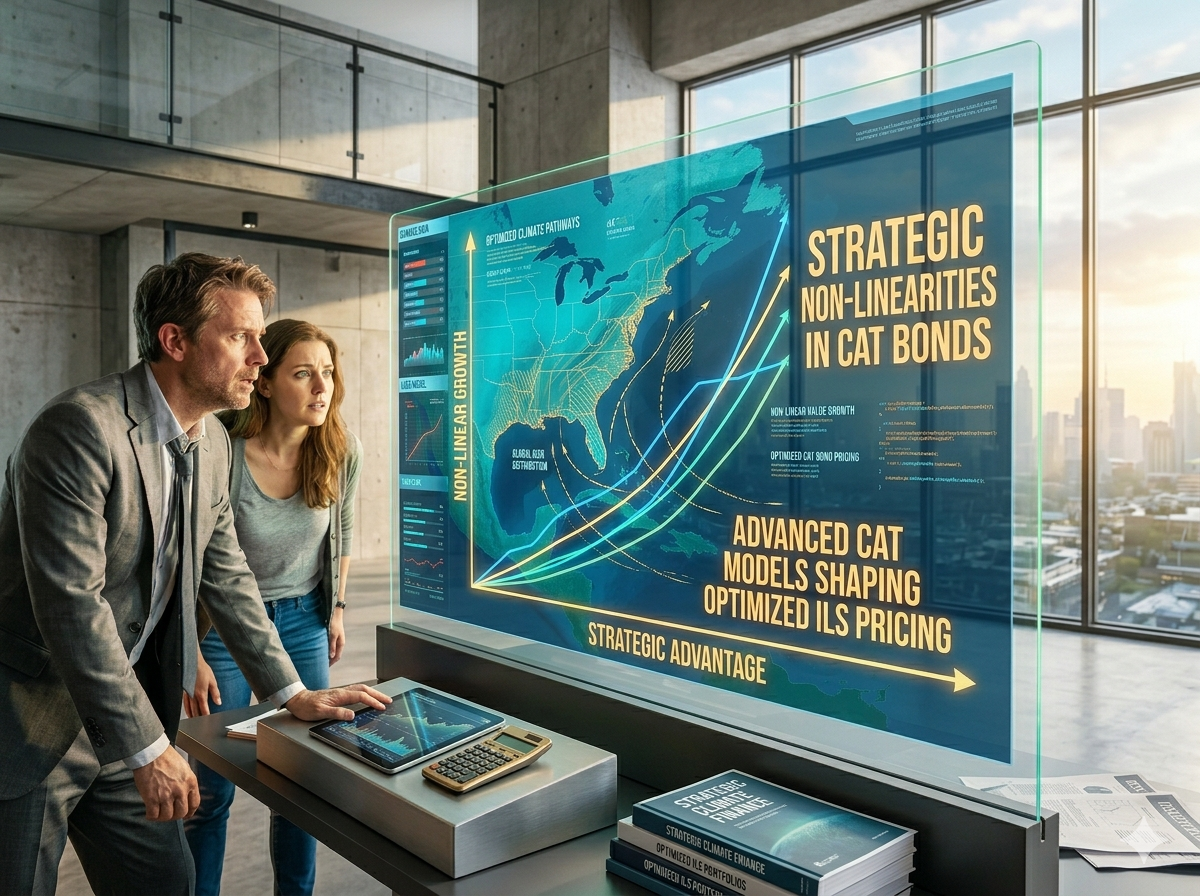
Catastrophe bonds (cat bonds) have long been the darling of alternative risk premia strategies: uncorrelated to equities, 8–12% yields, and binary loss triggers. That world is ending. Climate change is altering hurricane frequency, wildfire severity, and flood patterns faster than models can recalibrate. The result is negative convexity—the relationship between loss probability and bond price becomes inverted. A cat bond that should have a 2% annual default probability suddenly has 5% after a single ocean temperature anomaly. But because cat bonds trade infrequently, prices adjust with a lag. Sophisticated investors can front-run this repricing, but the bigger story is that traditional insurance-linked securities (ILS) models, built on 30 years of historical data, are now dangerously backward-looking. The 2026 Atlantic hurricane season is forecast to have 25 named storms; the 1990–2020 average was 12. Negative convexity means losses are no longer tail events—they are new normals.
Analysis:
Convexity in cat bonds refers to the bond’s price sensitivity to changes in modeled loss probability. Positive convexity means price drops slowly as risk rises; negative convexity means price collapses once a threshold is crossed. Climate change has shifted multiple thresholds. For Florida wind cat bonds, the threshold was historically a Category 4 landfall in Miami-Dade. Now, a Category 3 in Palm Beach can trigger the same loss because sea-level rise increases storm surge damage by 40%. Risk models from RMS and AIR have tried to incorporate climate scenarios, but they disagree wildly: for a typical $100 million Florida cat bond, 2026 loss probabilities range from 2.1% (RMS) to 6.8% (AIR). That 4.7 percentage point spread is the highest in a decade. Investors holding cat bonds are effectively short a climate option that is rapidly going in-the-money. The 2025 California wildfire cat bond losses of $1.2 billion were triple the modeled expected loss, yet yields have not adjusted because capital inflows to ILS remain strong (pension funds chasing yield).
Critique:
Progressive climate finance advocates have long warned that insurance markets are underpricing systemic risk. Cat bonds are the purest example. The critique is not that cat bonds are bad but that their pricing relies on an implicit subsidy from reinsurers and investors who accept backward-looking models because forward-looking models would demand 15–20% yields, which would make coastal real estate development uneconomical. In other words, cat bond yields are artificially low because no one wants to admit that Miami and parts of Houston are becoming uninsurable. A truly progressive policy would require cat bond issuers (insurance companies) to disclose climate-adjusted loss probabilities alongside historical ones, similar to the EU’s Sustainable Finance Disclosure Regulation. Without this, investors are buying bonds whose risk they cannot rationally price—a recipe for a concentrated loss event that could wipe out a decade of ILS returns in one season.
Capitalization Perspective:
Negative convexity is a trading opportunity, not just a warning. First, short cat bond ETFs (e.g., SRRI, CATS) using total return swaps, while buying out-of-the-money call options on reinsurance indices. When a major loss event hits, cat bond prices drop 30–50% in days; your short profits, and the reinsurance calls pay off. Second, write custom cat bond protection: sell put options on specific cat bonds that are most exposed to climate model divergence (Florida wind, California fire, European flood). The puts expire worthless in quiet years; in loss years, you pay but are hedged by the first strategy. Third, launch a “climate-resilient cat bond fund” that only invests in bonds with triggers based on objective physical metrics (e.g., wind speed at a specific anemometer) rather than modeled loss. These bonds trade at lower yields (6–8%) but have true convexity—they pay when the wind actually blows, not when a disputed model says it should. Progressive angle: use the profits from shorting mispriced cat bonds to endow a “Climate Risk Disclosure Litigation Fund” that sues rating agencies and issuers for failing to incorporate climate science, forcing the transparency that will ultimately stabilize the market.